Videos
Abstract
Humanoids have become increasingly agile and capable in real-world environments. To operate safely in dynamic scenarios, they must rapidly evade fast-moving obstacles while maintaining stability and physically feasible whole-body motion. Learning such behaviors remains challenging due to the high-dimensional dynamics of humanoid systems and the need to jointly balance reactive obstacle avoidance, motion naturalness, and control robustness. In this work, we present Humanoid Dodgeball, a reinforcement learning (RL) framework for agile dynamic obstacle avoidance in humanoids. Our method enables highly dynamic whole-body evasive maneuvers against incoming projectiles through threat-aware reward shaping, while multiple direction-specific adversarial motion priors regularize the learned behaviors toward stable and diverse human-like motions. Extensive simulation and hardware experiments demonstrate that the proposed framework substantially improves dynamic obstacle avoidance performance across diverse obstacle speeds and launch distances, while preserving robust and physically plausible humanoid motions.
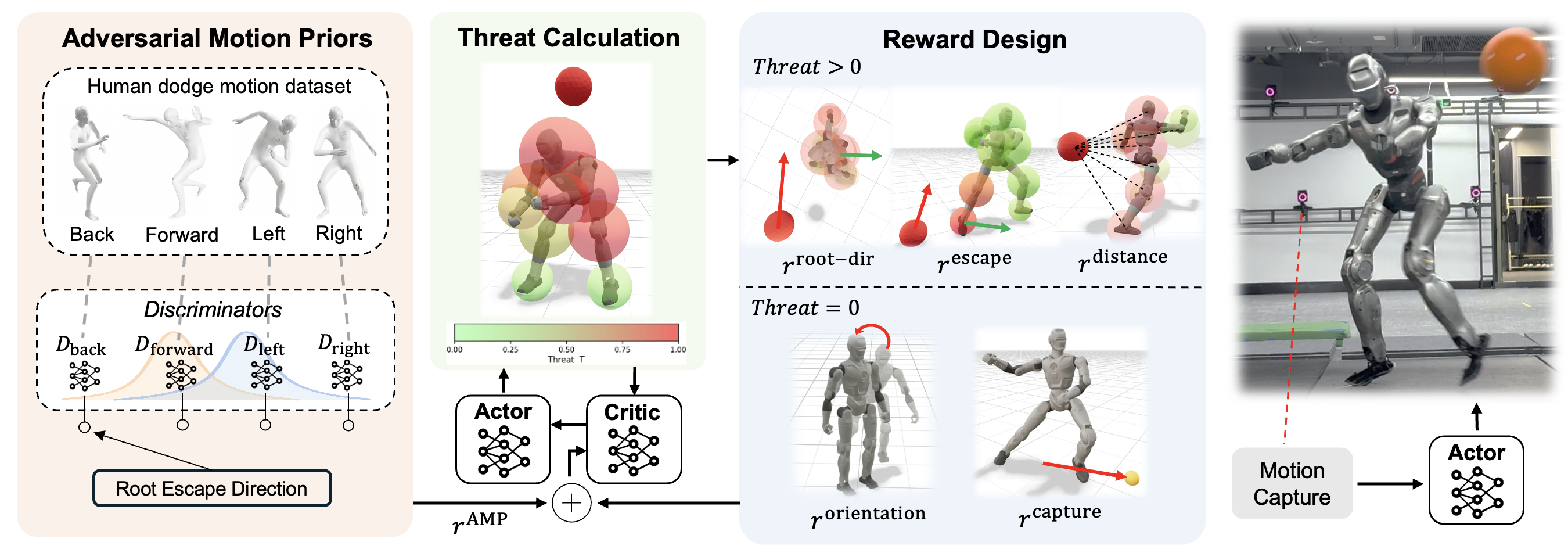
Overview of Humanoid Dodgeball. During simulation training, predictive and near-field threat for key bodies are computed to characterize incoming projectile hazards and guide threat-aware reward shaping for whole-body evasion. Direction-specific adversarial motion priors, selected according to the root escape direction, regularize the learned behaviors toward diverse and natural human-like dodge motions. When the threat subsides, recovery rewards, including orientation and capture-point objectives, encourage rapid stabilization. During hardware deployment, the trained actor is executed using obstacle positions estimated from the motion-capture system.